
Fiber Connector End-Face Inspection and Cleaning: A Field Procedure
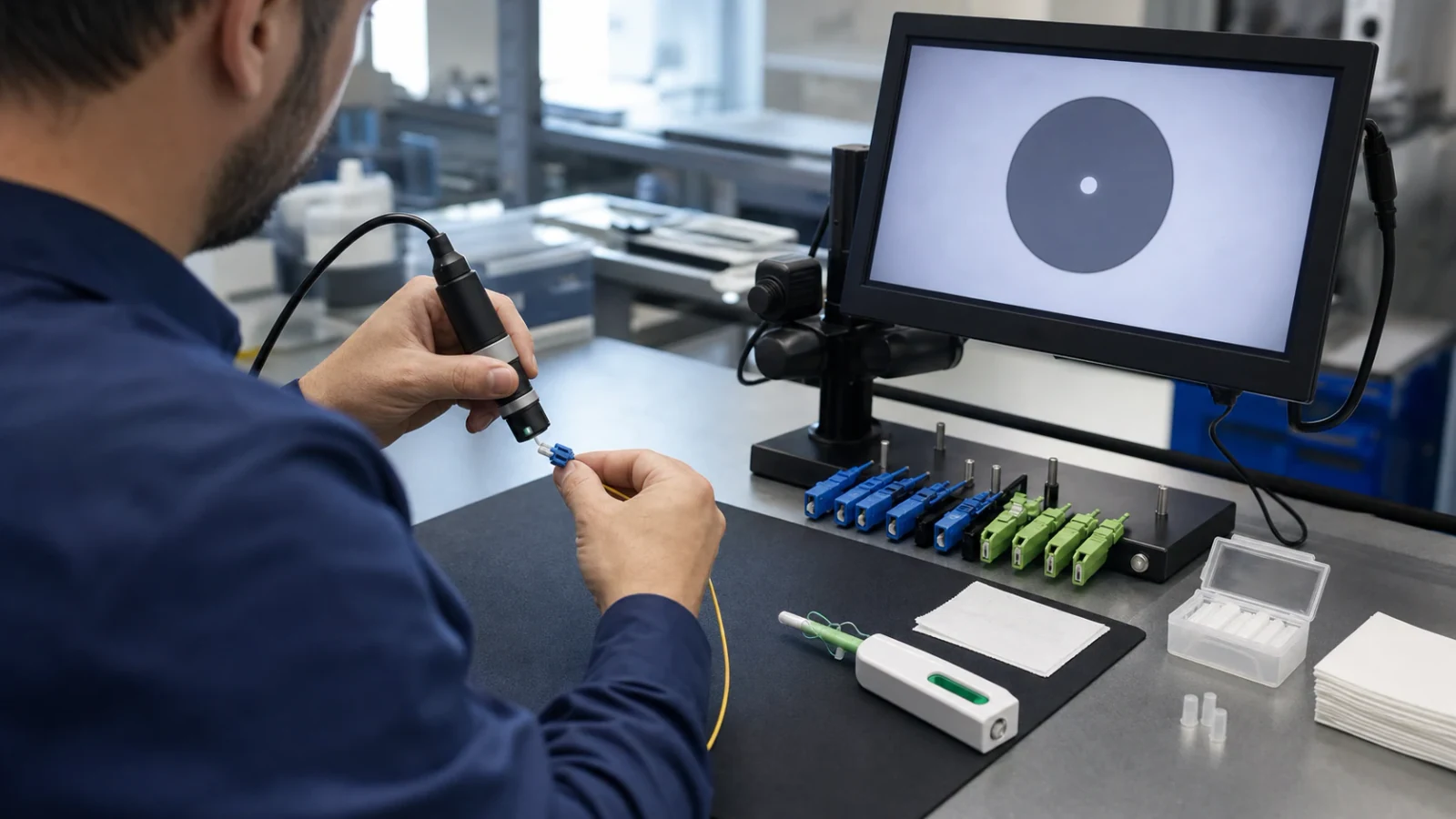
A practical inspect-clean-inspect workflow for fiber connector plugs, adapters, and equipment ports, with tool selection, safety controls, common failure modes, and escalation rules.
1. Why a small end-face defect can disrupt a link
A physical-contact connector places two fibre cores and their surrounding end-face areas in close contact. Dust, skin oil, polishing residue, moisture, or debris can prevent consistent contact, scatter light, increase attenuation, and increase reflection. Hard particles can also move during mating and scratch one or both surfaces.
A dust cap limits exposure during storage, but it can carry contamination of its own. Removing a cap is therefore not evidence that the connector is ready to mate. Inspection should be part of installation, troubleshooting, and maintenance, as well as final production control.
Engineering note: Visual inspection evaluates visible contamination and defects. It does not replace attenuation, return-loss, or end-face geometry measurements when those measurements are required.
2. Make the optical system safe before inspection
Do not look into a fibre, connector, transceiver, or inspection scope with the unaided eye. Disable or disconnect the optical source according to the site procedure, verify the state of the circuit, and use inspection equipment designed for fibre work. Video probes keep the operator separated from the optical path and are preferable for many field applications.
An optical fibre communication system can make optical power accessible far from the transmitter, particularly where amplifiers or high-power sources are used. The system owner should define the hazard level, lockout or shutdown method, and approved instruments in accordance with the applicable safety program. Cleaning solvents also require attention to ventilation, flammability, material compatibility, and the supplier safety data sheet.
- Identify the circuit and obtain permission before interrupting service.
- Disable the source and confirm the safe state using the approved method.
- Select the correct probe tip before approaching the connector or port.
- Keep disconnected ends capped or protected while other work is performed.
3. Follow the inspect-clean-inspect loop
First inspect the end face and classify what is visible. If it meets the applicable criteria, avoid unnecessary cleaning and protect it until mating. If it fails, clean with a method appropriate to the interface, then inspect again. Repeat only with a justified change of method; repeated identical cleaning without improvement suggests a damaged surface, a dirty tool, or the wrong accessory.
Inspect both mating sides immediately before connection. For a patch cord, that means the plug and the adapter or equipment receptacle. When one side is inaccessible, use the correct probe tip rather than inserting an unsuitable swab or forcing a plug cleaner into the port.
- Inspect before the first connection, after cleaning, and after any event that can expose the interface.
- Keep the probe tip clean and focus on the correct fibre and contact zones.
- Do not mate a passing connector to an uninspected interface.
- Record an image or result when the quality plan requires objective evidence.
4. Distinguish removable contamination from permanent damage
Loose particles and some films can be removed by cleaning. Scratches, pits, cracks, chipped fibre, and severe epoxy defects are not cleaning problems. Their disposition depends on the applicable inspection criteria and whether the connector can be professionally repolished without violating geometry or dimensional requirements.
A mark that stays in the same position after a correctly performed clean-and-reinspect cycle is more likely to be a defect than loose debris. A mark that changes position may indicate contamination or a dirty cleaning surface. Do not attempt to measure scratch dimensions by eye unless the approved inspection system and procedure are designed for that purpose.
5. Choose a cleaning method for the interface and contaminant
No single tool is correct for every connector. The cleaning surface must fit the plug, adapter, transceiver receptacle, or multifibre ferrule without damaging alignment features. Use lint-free materials intended for fibre connectors and follow the tool manufacturer’s limits on reuse.
| Situation | Preferred starting method | When to escalate | Key control |
|---|---|---|---|
| Exposed single-fibre plug | Approved cassette, reel, or dedicated dry cleaning surface | Use approved wet-to-dry cleaning if a film remains | Use a fresh area for each cleaning action |
| Connector inside an adapter or equipment port | Correct-size one-click tool or dedicated swab | Use a compatible wet-to-dry port method if allowed | Do not force an oversized tip into the sleeve |
| Multifibre ferrule | Tool designed for the exact ferrule and guide-pin arrangement | Follow the connector maker’s method for persistent debris | Clean the full contact area and protect guide features |
| Oily or strongly adhered contamination | Small amount of approved solvent followed by a dry finish | Quarantine if residue persists after a fresh method | Do not leave solvent pooled on the end face |
| Repeated failure after proper cleaning | Stop and reinspect the tool, probe, and interface | Replace or route for qualified repair | Avoid unlimited cleaning or uncontrolled repolishing |
6. Clean without transferring contamination
For an exposed plug, hold the connector so the ferrule contacts a clean portion of the approved surface with the specified pressure and motion. Do not scrub back and forth over a used area. For a port, insert the correct tool straight and operate it as designed; side loading can damage the sleeve or leave part of the end face untouched.
When a wet method is necessary, use only a compatible, residue-controlled fluid in a small quantity and finish on a dry area. This helps carry contamination away rather than redistributing a film. Household tissues, cotton buds, canned air with unknown propellant, clothing, and bare fingers are not controlled cleaning methods.
- Keep caps, probe tips, swabs, and cleaners in clean closed storage.
- Do not reuse a disposable swab or a visibly soiled cleaning zone.
- Prevent cleaning fluid from entering equipment where the procedure does not permit it.
- Allow the interface to dry and reinspect before mating.
7. Know when to stop and escalate
Stop if the connector remains unacceptable after correctly applied dry and approved wet-to-dry methods, if a crack or chip is visible, if the ferrule is loose, or if the connector body is mechanically damaged. Mark and isolate the item so it cannot be returned to service accidentally.
Repolishing is a manufacturing or repair process that requires suitable fixtures, films, geometry control, and final optical testing. It is not a substitute for field cleaning. Equipment receptacles and transceiver stubs may require vendor-specific service; aggressive cleaning can turn a replaceable contamination issue into permanent damage.
8. Use a repeatable field checklist
A short, enforced checklist is more reliable than a long procedure used only during audits. Train technicians to recognise connector families and polish types, maintain clean consumables, and treat repeated contamination as a process problem rather than an unavoidable field condition.
- Identify the link, connector type, polish, and accessible side of each interface.
- Place the system in its approved safe state and select the correct inspection tip.
- Inspect the plug and receptacle; save evidence when required.
- Clean only the failing interface with an approved tool and fresh cleaning surface.
- Reinspect, then mate immediately or install a clean protective cap.
- Measure link performance when required and record any replaced or quarantined component.
Related Fibtele product categories
Final specifications, standards, compatibility, MOQ and lead time must be confirmed for the selected model before ordering.
Primary references
- IEC 61300-3-35:2022 — Visual inspection of fibre optic connector interfaces — International Electrotechnical Commission
- IEC TR 62627-01:2023 — Fibre optic connector cleaning methods — International Electrotechnical Commission
- IEC 60825-2:2021 — Safety of optical fibre communication systems — International Electrotechnical Commission
Standards are revised over time. Check the current edition and the project specification before approving a design or purchase.